


Industrial UV Ink
Why Choose Us
Factory Strength
Our factory established in 1990, initially produced wall paint, and migrated to the era of digital inkjet printing in 2001 and started the R&D and production of digital inkjet printing ink. Coboink becomes one of China's leading providers of digital inkjet printing consumables, and printing solutions with an annual production capacity of over 10000 tons.
Advanced Molding Production Line
We have many the most advanced full-automatic barrel molding production lines, full automatic continuous filling lines, pulsating filling intelligent control system, realizes 24-hour automatic production, efficiently meets the needs of customized and personalized orders.
Our Certifications
The factory has certificated with ISO9001 and ISO14001 , also been granted the certificate of OHSAS18001 by the occupational health and safety bureau and other related certifications by national environmental authority.
After-sales Service
Deeply cultivate the chemical industry for 32 years, with a senior R & D team, a complete product after-sales service system to ensure product stability and to provide after-sales service protection for customers .
UV-curable inks contain photoinitiators that cause the ink to harden when exposed to UV light. They produce a durable, scratch-resistant finish and can be used on almost any surface. However, UV inks require specialized printers and curing equipment. They are often used for high-quality product labels, membrane switches, and touchscreen displays.With various types of industrial inkjet inks available, you can choose the right solution for your specific application and substrate. Whether you need an eco-friendly option for paper or a durable ink for plastics, InkJet, Inc. formulates inks to meet your unique needs. Our expertise in ink chemistry and printing technology allows us to provide the high-performance inks and the guidance to help your business thrive.


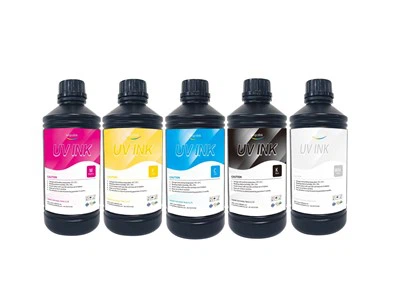


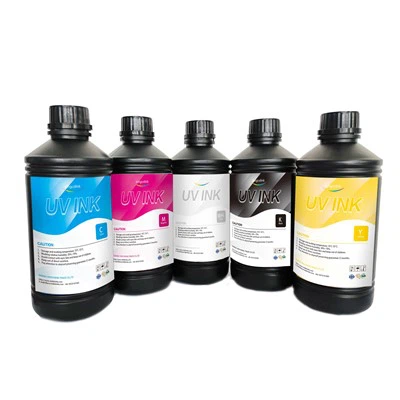

High cost performance ratio of Industrial UV Ink
Industrial UV Ink has no solvent volatilization during the printing process, and solid substances remain 100% on the substrate. The color strength and dot structure remain basically unchanged, and a very thin ink layer thickness can achieve good printing results. Although Industrial UV Ink is more expensive than solvent based ink, 1kg Industrial UV Ink can print 70 square meters of printed matter, while 1kg solvent based ink can only print 30 square meters of printed matter.
Industrial UV Ink can dry instantly and has high production efficiency
Industrial UV Ink can quickly solidify and dry under the irradiation of ultraviolet radiation, and the printed products can be immediately stacked and processed. The production speed is 120-140m/min, and it can also save 60% to 80% of the storage area.
Industrial UV Ink does not pollute the environment
Industrial UV Ink does not contain volatile solvents, i.e. a 100% solvent free formula, so organic volatiles are not emitted into the air during the printing process. This complies with environmental regulations and also eliminates solvent recovery costs.
Industrial UV Ink is safe and reliable
Industrial UV Ink is a system that does not require water or organic solvents. Once the ink solidifies, the ink film is strong and chemically resistant, without damage or peeling caused by contact with chemicals. Industrial UV Ink is safe to use and can save insurance costs for users. It is suitable for packaging and printing materials with high hygiene requirements such as food, beverage, and drugs.
Excellent Industrial UV Ink printing quality
During the printing process, Industrial UV Ink can maintain a uniform and consistent color, the ink layer of the printed product is firm, the proportion of color and connecting materials remains unchanged, the dot deformation is small, and it dries instantly, allowing it to complete multi-color overprinting.Industrial UV Ink has stable propertiesIndustrial UV Ink only solidifies under UV light irradiation, and the non drying time under natural conditions is almost infinite. This non drying characteristic ensures that the ink viscosity remains stable during long-term operation of the printing machine.
Flexographic Printing
Industrial UV Ink are particularly useful for printing applications in high-speed environments such as creating labels or packaging items. A flexible plate is able to transfer the image to the substrate which is cured instantly using UV light.
Signage
Industrial UV Ink are a great solution for creating signage and digital graphics on atypical and unusual substrates.
Personalisation
The fast drying time of Industrial UV Ink means it is possible to print high quality digital images onto a variety of personalised items such as glass bottles, phone cases, golf balls, keyrings and more.
Backlit Films
A UV printer can create film or fabric that is designed to be backlit. This is useful for menus, signage, wall art, advertising posters, billboards, and more. Ink is fade and moisture resistant for lasting effects.

What is Industrial UV Ink Made of ?
Polymeric Prepolymer
Polymeric prepolymer is an important constituent to decide the performance of UV coating, also the basic of UV ink to film. It plays an important role in the process of UV curing and cured film properties. It is generally classified according to the skeleton structure, which affects the coating hardness, abrasion resistance, adhesion, light resistance, chemical resistance and water resistance, etc.
Photosensitive Monomer
Photosensitive monomer is reactive diluent. UV ink and varnish should have a proper viscosity when being coated. It typically reduces the prepolymer viscosity by adding 20%~80% of the monomers, simultaneously the monomer polymerizes itself and becomes part of the cured film.
Reactive Diluent
Reactive diluent is also called cross-linking monomers, a functional monomer which is to adjust the ink viscosity, curing rate and curing film properties. When choosing the monomer, the monomer with low viscosity, good dilution effect, fast curing, strong adhesion, no skin irritation and no smell in the coating is good.
The Photoinitiator
The photoinitiator is the main ingredient of UV curing system, too. It can absorb the radiation energy and produce the active intermediate which has the ability of initiator polymerization through chemical change. It is divided into hydrogen abstraction type and cracking type. The photo initiator is better to have high UV light absorption efficiency and good relative stability.
How to Choose Industrial UV Ink

Substrate Compatibility
Match the ink to the intended printing substrate, whether porous or non-porous. Solvent pigment inks are required for non-porous materials.
Durability Requirements
For applications requiring maximum durability and longevity, choose a pigment ink formulated for outdoor/industrial use.
Environmental Impact
Water-based pigment inks are more environmentally friendly than solvent-based inks. Choose accordingly based on ventilation capabilities.
Color Needs
Choose between process color (CMYK), spot color or custom-matched inks depending on color requirements. Process inks provide a wide color gamut, while spot/custom inks provide precise color matching.
Drying Method of Industrial Uv Ink
Volatile drying
The solvent or water in the ink is evaporated and dried by heating. Solvent inks are not good for the environment because they contain VOCs. In order to make water-based solvents or high boiling point solvent ink drying must be equipped with a large oven, the corresponding energy consumption is also very large. The ink film after drying is only the ink in the solid components in the substrate attached to the formation of the strength of the ink film is also the strength of the connecting material itself.
Penetration drying
The solvent and water in the ink and other low-viscosity components penetrate into the substrate material, resin, pigment and other solid components attached to the surface of the substrate drying method. This type of drying ink can be used for paper type porous absorbent materials, but can not be used for non-permeable materials (such as plastics, etc.). The penetration drying method is used as a drying method for newspaper printing, with a short drying time and no need for drying equipment. When using this type of ink for color printing, the ink needs to be allowed to dry without losing color after being printed on the substrate.
Oxidation polymerization drying
Oxidative polymerization type ink uses linseed oil and soybean oil and other fats with double bonds as connecting material, which can dry with the oxygen in the air by oxidative polymerization reaction. With the penetration of the same drying method, although the drying does not require equipment and does not consume energy, but requires a certain amount of drying time, can not immediately enter the next process. In addition, powder coating is performed to prevent the backside from sticking to the dirt, which can cause environmental problems during operation.
Heat curing
Heat-curing ink using epoxy resins, polyurethane resins and amino resins and other heat-curing crosslinking resins as a connecting material, while matching the heat curing agent, for the two-component system, when used in a certain proportion of mixing and stirring, infrared baking channel or hot air heating, thermal crosslinking occurs and curing of the film. Heat-curing ink performance is excellent, but energy consumption, and solvent volatilization, not environmentally friendly, so many varieties of energy-saving and environmentally friendly UV ink replaced.
Top Considerations for Managing Industrial UV Ink
Managing Expiry Dates
UV LED inks, like all printing inks, have a shelf life. JHF's ink shelf life is up to 12 months.Using expired ink can lead to poor print quality due to change in viscosity or consistency and may harm your equipment, particularly the print heads. Regularly check the expiry dates on your ink supplies and prioritize using inks that are closest to their expiration. Develop a system for rotating stock to ensure older inks are used first.
Curing Process Optimization
The quality of the final print is highly dependent on the curing process. Factors such as the intensity of the UV light, the speed of the curing unit, and the type of substrate being printed on can all affect the outcome. Proper calibration of the curing unit is essential to achieve the desired print quality and durability. Also cleaning the glass lens weekly on UV LED lamp will help cure inks consistently while printing.
Environmental and Health Considerations
While UV LED inks are lauded for being more environmentally friendly than solvent-based inks, due to their lack of volatile organic compounds (VOCs), they still require responsible disposal practices. Familiarize yourself with local regulations regarding the disposal of UV LED ink waste and containers to ensure compliance with environmental standards.
Health and Safety Precautions
Ensure the printing area is well-ventilated.In some cases where you are in a small room or residential office, consider a fume extraction system to limit fumes.Use protective gear to minimize health risks from UV LED ink exposure when refilling or performing maintenance. Adhere strictly to the ink manufacturer's safety protocols.
Our factory
Our factory established in 1990, initially produced wall paint, and migrated to the era of digital inkjet printing in 2001 and started the R&D and production of digital inkjet printing ink. Coboink becomes one of China's leading providers of digital inkjet printing consumables, and printing solutions with an annual production capacity of over 10000 tons.The factory has certificated with ISO9001 and ISO14001 , also been granted the certificate of OHSAS18001 by the occupational health and safety bureau and other related certifications by national environmental authority. The factory has adopted an high standards disposal management system. All of ink ingredients are free of benzene, ketone and heavy metals. The production process is green and environment-friendly. The products meet the requirements of RoHS,REACH and other relevant international laws and regulations.


FAQ
As one of the most professional industrial UV ink manufacturers and suppliers in China, we're featured by quality products and good service. Please rest assured to buy industrial UV ink made in China here from our factory.
UV Ink For Ricoh Gh2220, Uv ink for konica 1024a, UV Ink For Ricoh